

Bangkok vs. Chiang Mai vs. Phuket vs. Krabi: Which Thailand Destinations Should You Visit?
- 6 days ago
- 8 min read
Updated: 4 days ago
The Short Answer
Bangkok belongs in almost every Thailand itinerary — it's the international gateway, the cultural anchor, and the easiest city to build a route around. From there, the right pairing depends on what you actually want: Chiang Mai for temples, mountains, and a slower northern pace; Phuket for polished beaches, resorts, and easy nightlife; or Krabi for dramatic limestone cliffs, rock climbing, and a quieter stretch of the same Andaman coast. Most first-time trips work best with Bangkok plus one or two of the other three — trying to cram all four into under two weeks usually means more time in transit than in any single place. This is exactly the kind of decision Zensseys helps travelers make before they've booked a single flight.
Bangkok, Chiang Mai, Phuket, and Krabi at a Glance
Each of these four stops does a completely different job in a Thailand trip, and none of them is a substitute for the others. Here's the fastest way to place them on a map before comparing details below.
Bangkok — Thailand's capital and the country's main international gateway. Temples, riverside markets, rooftop bars, and world-class street food, all inside one fast-moving city.
Chiang Mai — a northern mountain city built around a 700-year-old walled Old City, jungle day trips, and a noticeably slower pace than Bangkok.
Phuket — Thailand's largest island and its most developed beach destination, with international resorts, nightlife, and easy boat access to Phi Phi and James Bond Island.
Krabi — a mainland Andaman Coast province known for karst cliffs, Railay Beach, and a more low-key version of Phuket's coastline.

Beaches
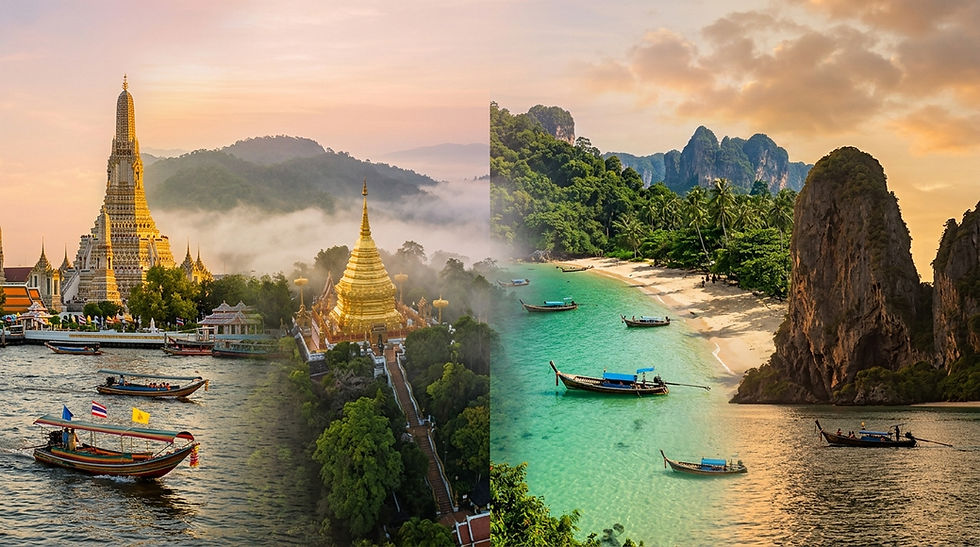
If beaches are the priority, Phuket and Krabi both deliver, but in different registers. Phuket's beaches — Patong, Karon, Kata — sit next to a fully built-out resort infrastructure, so you get powder-soft sand alongside beach clubs, water sports operators, and a five-minute walk to dinner. Krabi's coastline, especially Railay and Ao Nang, trades some of that convenience for scenery: towering limestone karsts rising straight out of turquoise water, the kind of view that shows up on Thailand postcards. Bangkok has no real beach to speak of, and Chiang Mai is landlocked in the mountains — neither belongs in this comparison on beach quality alone.
Nightlife
Bangkok and Phuket are the nightlife destinations here. Bangkok's scene runs from rooftop bars with skyline views to Khao San Road's backpacker chaos to speakeasy-style cocktail bars that book out days in advance. Phuket's Patong strip is louder and more concentrated — bars, clubs, and street entertainment packed into a few dense blocks near the beach. Chiang Mai has a mellower version built around live music venues and night bazaars rather than club culture, and Krabi's nightlife is limited to a handful of beach bars in Ao Nang — fine for a low-key evening, not a destination in itself.
Zensseys Tip: If nightlife is a real priority, don't split your remaining nights evenly between Phuket and Krabi hoping to compare them. Pick Phuket for the concentrated bar scene, or pick Krabi for the scenery and quiet — trying to do both on a short trip usually means an underwhelming version of each.
Not Sure Which Thailand Stops Fit You? Tell us your dates, budget, and travel style, and we'll help you figure out where to go. Book a Free Travel Consultation with Zensseys.
Food and Culture
Bangkok and Chiang Mai are the strongest food and culture stops. Bangkok's street food scene is genuinely world-class — from Michelin-recognized stalls to 24-hour markets — and its temple complexes, including the Grand Palace and Wat Arun, deliver the most concentrated dose of Thai history in the country. Chiang Mai leans into northern Thai cuisine (think khao soi and sai oua sausage), a much higher density of Buddhist temples inside the Old City walls, and hands-on cultural experiences like Thai cooking classes and monk chat sessions that are harder to find elsewhere. Phuket and Krabi have good food, but it's largely built around resort dining and seafood rather than a distinct culinary identity of their own.
Adventure and Outdoor Activities
Krabi wins on adventure by a wide margin. Its limestone cliffs at Railay and Tonsai have made it one of Southeast Asia's best-known rock climbing destinations, with routes for complete beginners through advanced climbers, plus sea kayaking, cave exploring, and jungle waterfall hikes. Chiang Mai's version of adventure runs through the mountains — jungle trekking, waterfall day trips, and zip-lining through the canopy outside the city. Phuket offers island-hopping and diving or snorkeling day trips rather than land-based adventure, and Bangkok's outdoor options are limited to day trips out to national parks a few hours from the city.
Romance and Honeymoons
For honeymoons and romantic trips, Krabi and Phuket both work well for the beach-resort half of a trip, but Krabi's dramatic scenery and quieter pace tend to photograph better and feel more private. Pairing a few nights in Krabi or on a private island like Koh Yao Noi with a cultural stretch in Bangkok or Chiang Mai is one of the most consistently successful honeymoon structures in this part of Thailand — enough contrast between city and coast that neither half feels repetitive. Zensseys' breakdown of what couples actually spend on a Thailand honeymoon is a useful next read if this is the direction you're leaning.
Families
Families traveling with kids generally do best with fewer, longer stops rather than four rushed destinations. Phuket's resort infrastructure — kids' clubs, calm swimming beaches at Kata and Karon, and short transfer times from the airport — makes it the easiest beach base for families. Chiang Mai adds genuinely kid-friendly activities like ethical elephant sanctuaries and cooking classes. Bangkok works for families in small doses, two to three days, but its heat, traffic, and pace can wear younger kids down fast if it isn't balanced with slower time elsewhere.
Zensseys Tip: Experienced Thailand travelers on forums consistently land on the same rule of thumb: you lose close to half a day every time you change cities, so a stop needs at least three nights to actually deliver two full, unhurried days. Four one-night stops rarely beat two well-chosen three-night stops, even though the four-stop version looks more impressive on paper.
Luxury and Cost
Bangkok and Phuket have the deepest bench of true five-star and ultra-luxury properties — international flag hotels, riverside resorts, and private-pool villas concentrated in both cities. Krabi and Chiang Mai have excellent high-end options too, just fewer of them, which can actually work in your favor if privacy and low guest density matter more than brand-name amenities. On cost, Chiang Mai and Krabi tend to run cheaper across the board — hotels, food, and activities — while Bangkok and Phuket carry a premium tied to demand and international flight access.
Getting Between Them
All four are connected by frequent domestic flights out of Bangkok, typically running about one hour to Chiang Mai, Phuket, or Krabi, with one-way economy fares often landing in the $50–$90 range if booked a few weeks out. Flying directly between Chiang Mai and Phuket or Krabi is possible but less frequent and usually pricier — often close to two hours in the air, sometimes with a connection through Bangkok. For that reason, most itineraries that include Chiang Mai plus a beach destination route back through Bangkok rather than flying point-to-point between the north and the south.
Zensseys Tip: Book Bangkok as your open-jaw entry and exit point whenever the itinerary allows it — flying into Bangkok and out of Phuket, or vice versa, skips a redundant flight back through the capital and can save the better part of a travel day.
How Many Nights in Each City?
As a starting framework: Bangkok generally earns 2–4 nights, with 3 being the sweet spot for most travelers, Chiang Mai 3–4 nights, and Phuket or Krabi 3–5 nights depending on how much beach time you want. These aren't rigid rules — a food-focused traveler might give Bangkok 5 nights and skip a beach stop entirely, while a beach-first traveler might cut Bangkok to 2 nights and add an extra day in Krabi.
Which Combination Actually Makes Sense?
The right combination depends on how many days you have and what you're actually optimizing for. These aren't universal rules, just starting frameworks based on the tradeoffs above — they're where a travel advisor's judgment matters more than a generic checklist.
7 days: Bangkok + one other destination — don't try to add a second beach or city stop.
10 days: Bangkok + Chiang Mai + one beach destination (Phuket or Krabi).
14 days: Bangkok + Chiang Mai + Phuket and/or Krabi, with real time to breathe in each.
First Thailand trip: Bangkok + Chiang Mai + Krabi — the combination that shows the widest range of what the country offers.
Honeymoon: Bangkok + Chiang Mai + Krabi or Railay for the scenery and privacy.
Nightlife-focused trip: Bangkok + Phuket.
Culture-and-food-focused trip: Bangkok + Chiang Mai.
For a closer look at how this plays out day by day, Zensseys' 9-day Thailand itinerary walks through the Bangkok–Chiang Mai–Krabi combination in detail, and the 14-day adventure itinerary is a good reference if you have more time to work with and want to add adrenaline-heavy days into the mix.
Already Know You Want Thailand? Skip the hours of research. Zensseys can build your personalized route, starting with your first working itinerary within 24 hours. Plan My Thailand Trip with Zensseys' Full Trip Planning & Booking service.
Packing for a Multi-City Thailand Trip
A route that touches mountains, cities, and beaches in the same trip means packing for very different conditions in a short window. A well-made pair of polarized sunglasses like Ray-Ban or Maui Jim sunglasses earns its space for both the beach glare in Phuket or Krabi and the sun exposure on Chiang Mai's temple visits, and a durable YETI Rambler insulated bottle is worth packing for the jungle treks and waterfall days up north, where bottled water isn't always easy to find.
Verdict
There's no single right answer to Bangkok vs. Chiang Mai vs. Phuket vs. Krabi — the real question is which combination fits your dates, budget, and travel style, not which one destination "wins." Bangkok anchors nearly every route. Chiang Mai adds culture and mountains. Phuket adds polish and nightlife. Krabi adds scenery and adventure. For a deeper look at the two beach options head-to-head, Krabi vs. Phuket: Which Andaman Coast Base Should You Choose? breaks it down further, and Zensseys' Thailand travel page is a good next stop for browsing the destination as a whole.
Frequently Asked Questions
Should I try to visit all four cities on my first trip to Thailand? Usually not. Four destinations in under two weeks means more time in transit than in any one place — most first-time travelers get more out of Bangkok plus two of the other three, spending real time in each rather than rushing through all four.
What's the best combination for a 10-day Thailand trip? Bangkok, Chiang Mai, and one beach destination (Phuket or Krabi) is the most reliable 10-day structure — roughly 3–4 nights in Bangkok, 3 in Chiang Mai, and 3–4 on the coast.
Is Chiang Mai worth visiting if I only want beach time? Not really, on its own — Chiang Mai is landlocked and built around mountains, temples, and culture rather than coastline. It pairs well with a beach stop, but it isn't a beach destination in itself.
Is Phuket or Bangkok better for nightlife? Both are strong, but for different styles. Bangkok has more range — rooftop bars, cocktail bars, and backpacker strips in one city — while Phuket's Patong area concentrates beach-adjacent bars and clubs into a smaller, louder footprint.
How do I actually get between Bangkok, Chiang Mai, Phuket, and Krabi? Domestic flights out of Bangkok are the fastest option, generally around an hour to any of the other three. Flying directly between Chiang Mai and the south is possible but less frequent, which is why most multi-city routes funnel back through Bangkok.
Your Thailand Trip Doesn't Have to Look Like Everyone Else's. We'll help determine which destinations actually fit your time, budget, and travel style — and coordinate the trip from there. As a service-disabled veteran-owned travel advisory, Zensseys offers a Free Travel Consultation to start the conversation, or full Trip Planning & Booking for $199 if you're ready to move. Call or text William directly at (210) 239-7540.
William Harris is the founder and lead travel advisor at Zensseys, a service-disabled veteran-owned luxury travel advisory specializing in Thailand, Vietnam, and Indonesia/Bali. Meet William here.




Comments