


Why a DIY Thailand, Cambodia, and Laos Trip Keeps Falling Apart at the Border (And What a Travel Advisor Fixes)

Cutting to the Chase
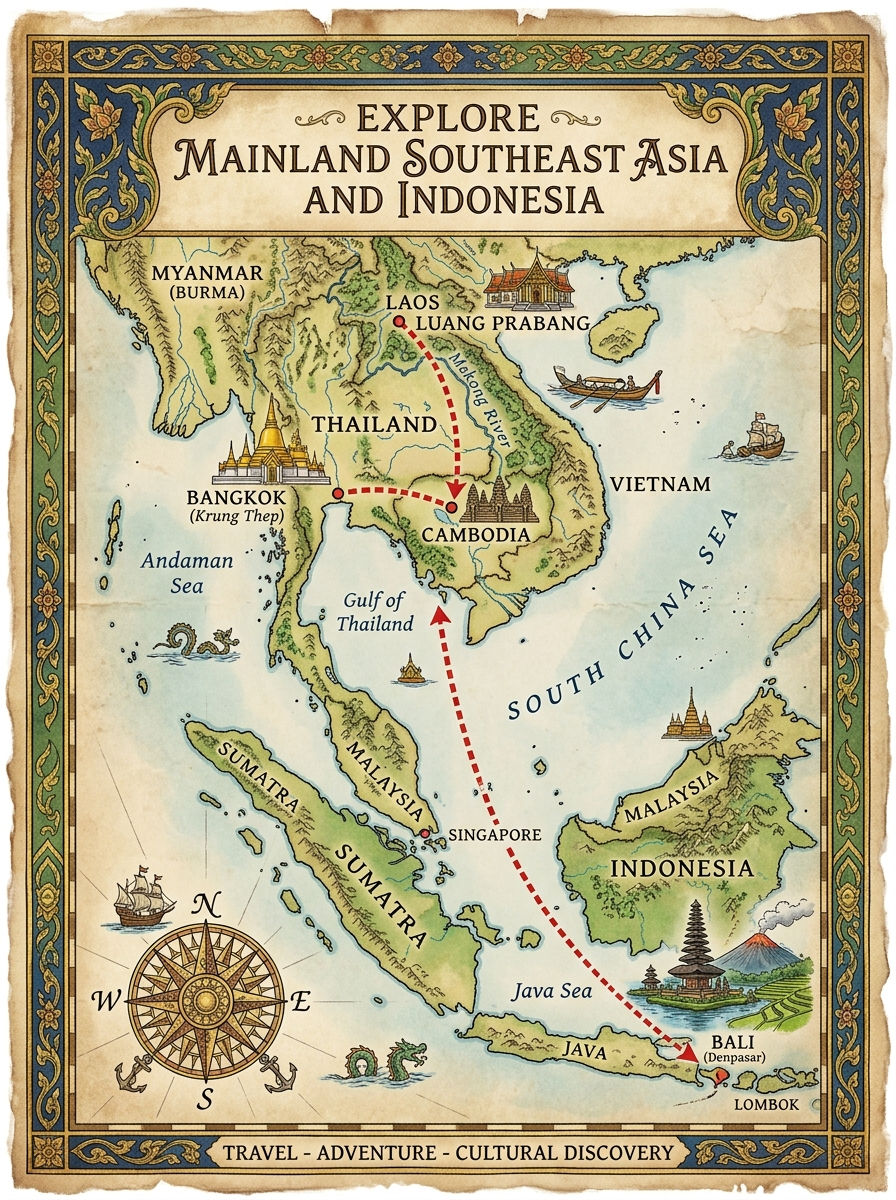
A travel advisor's real value on a Thailand, Cambodia, Laos, or Indonesia trip isn't picking a nicer hotel — it's catching the border closures, visa mismatches, and re-routing problems that a DIY itinerary finds out about at the airport counter. Right now, every land crossing between Thailand and Cambodia is closed. Anyone who built a route around a Bangkok-to-Siem Reap bus is going to be rebuilding that leg from scratch, and most people don't find out until they're already holding a bus ticket that doesn't work. A travel advisor who works this region every week catches that before a single flight gets booked.
That's the actual argument for using one on a multi-country Asia trip: not convenience, not luxury, but the fact that four countries means four sets of visa rules, four currencies, four sets of entry requirements, and at least one border situation that changed since the blog post you read last was written.
The Multi-Country Math Nobody Budgets For
Here's what a Thailand, Cambodia, Laos, and Indonesia trip actually costs in visa fees alone, and why the order you visit them in matters more than most people assume.
Indonesia's visa-on-arrival runs 500,000 Indonesian rupiah — about $35 USD at current exchange rates — plus a separate Bali tourism levy of roughly $10. From here on, every price in this article is in USD. Cambodia's e-visa is a flat $37 for most nationalities and takes about three business days to process, so it has to be requested before you fly, not at the gate. Laos issues a visa on arrival for $35 to $45 depending on nationality, or a $50 e-visa if you'd rather skip the counter — and as of September 2025, Laos also requires a separate Lao Digital Immigration Form for every entry and exit, on top of the visa itself. Thailand, meanwhile, dropped its visa-exempt stay for Americans from 60 days to 30 in 2026, which changes the math on how long you can realistically stay in-country before you need an exit stamp.
None of these fees is large on its own. Stacked across a four-country trip, with different processing windows, different passport-validity rules (several of these countries want six months of validity plus blank pages), and different documents required at different points, it's easy to apply for one visa too early, one too late, or discover a blank-page requirement the night before a flight.
Zensseys Tip: Apply for Cambodia's e-visa and Laos's e-visa in that order, about two to three weeks out — Cambodia's has the longer stated processing window, and doing it first means a delay there doesn't collide with your Laos entry date.
Why the Thailand–Cambodia Border Is Breaking DIY Itineraries Right Now
This is the piece most travel content hasn't caught up to. Thailand closed every one of its land border crossings with Cambodia in late June 2025 after a territorial dispute escalated into an armed conflict. A ceasefire signed on December 27, 2025 broke down within days, and as of the most recent reporting, all seven official crossings — including the Aranyaprathet–Poipet route that used to carry the classic Bangkok-to-Siem-Reap overland run — remain closed with no announced reopening date. The U.S. Embassy has renewed a do-not-travel advisory covering a roughly 50-kilometer band along the border across seven Thai provinces.
Flights between the two countries are operating normally, and the main tourist hubs — Bangkok, Chiang Mai, Phuket, Phnom Penh, Siem Reap and Angkor — are unaffected day to day. But if your itinerary assumed you could cross overland from Thailand into Cambodia, that assumption is currently wrong, and it typically adds $150 to $200 per person in flight costs to fix. This is exactly the kind of thing a multi-city Thailand itinerary needs rebuilt around, not discovered mid-trip.
Thailand to Laos Still Works Overland — If You Know Which Crossing
Here's the nuance most headlines skip: the Thailand-Cambodia closure isn't a Thailand-wide border shutdown. The Thailand-Laos crossings are open and running normally. The Friendship Bridge between Nong Khai and Vientiane, and the Chiang Khong–Huay Xai crossing near the Golden Triangle, both still process visas on arrival and are a normal part of a Thailand-into-Laos routing.
That distinction — one neighboring border closed, another wide open — is precisely the kind of detail that gets flattened into "the border is closed" by people who read one headline instead of tracking the actual advisory day to day. It's a small thing, but it's the difference between an itinerary that works and one that has to be rebuilt in an airport.
The Overplanning Trap (And Why It's Been the Same Mistake for 15 Years)
Scroll through the Thailand-Laos-Cambodia planning threads on a site like Travelfish and you'll find the same conversation repeating itself across more than a decade: a traveler posts a four-country, three-week itinerary, and the replies are almost always some version of "you're planning too much in too little time," with a warning that backtracking between regions eats far more travel time than the map suggests. It's such a consistent pattern that it's basically a rite of passage — cram Thailand, Cambodia, and Laos into three weeks, get gently talked down by strangers on a forum, and rebuild the route around fewer stops and less zigzagging.
That's not a knock on the travelers asking. It's a genuinely hard thing to judge from outside the region — how long a "quick stop" in Luang Prabang actually takes once you factor in the boat schedule, or whether flying Chiang Mai to Hanoi is even a direct route (it usually isn't; expect a Bangkok connection).
Zensseys Tip: If your itinerary has you doubling back through the same city twice, that's the itinerary telling you it's over-scheduled — not a scheduling problem to power through.
What a Travel Advisor Actually Does With All of This
This is the part that's easy to undersell. A good advisor working Thailand, Cambodia, Laos, and Indonesia isn't just booking hotels — they're sequencing the trip around the border realities above, matching each country's visa validity window to your actual dates, and swapping a bus leg for a flight before you've bought a nonrefundable ticket for a route that doesn't run anymore.
They're also the person who knows which on-ground operators in Siem Reap or Luang Prabang are reliable and which ones look identical online but aren't, which matters more in a region where reviews can be gamed and a bad transfer company can cost you a flight connection. And because a multi-country trip usually means multiple visas, entry cards, and currencies moving through the same daypack, a dedicated passport and travel wallet to keep it all sorted by country is one of the more genuinely useful things to pack — not glamorous, but it's the difference between finding your Cambodia e-visa printout in three seconds at immigration and holding up the line.
If you're trying to stretch airline miles or credit card points across four countries instead of paying cash for every leg, that's also squarely advisor territory — a lot of people don't realize how much of that can be built into the same booking instead of handled as a separate DIY project.
Indonesia, the Philippines, and Beyond: Same Principle, Different Border
Indonesia doesn't share a land border with mainland Southeast Asia, so the friction shows up differently — inter-island flights instead of overland crossings, a visa-on-arrival plus a separate Bali tourism levy plus a mandatory digital arrival card that has to be filed within 72 hours of landing, not at the airport counter. Miss that window and you're troubleshooting immigration paperwork instead of already being at your hotel in Ubud or Canggu.
The Philippines runs on the same logic again, just with its own quirks — inter-island flights, a different arrival form, and its own visa-free window. Zensseys is actively expanding coverage there as more clients start asking about it as a Southeast Asia add-on. Whatever the specific country, the pattern holds: more islands and more flights means more chances for a missed connection, which makes a Bluetooth luggage tracker a genuinely reasonable add to the packing list on any trip stacking four or more short-hop flights back to back.
The Bottom Line
Whether it's just Thailand or the full Thailand-Cambodia-Laos-Indonesia arc, the actual value of working with someone who does this daily isn't the itinerary itself — it's catching the border that's closed, the visa that needs to be filed a week earlier than you assumed, and the connection that only works one direction. If you're weighing whether that's worth it for your own trip, a free consultation is the lowest-friction way to find out what your specific route actually requires before you book anything. For travelers who want the whole thing handled — flights, visas, on-ground vetting, and the border-status babysitting — Zensseys' full trip planning and booking service exists for exactly that.
As a service-disabled veteran-owned advisory, Zensseys' Thailand-specific planning draws on firsthand time in the region rather than a call center script, and the same goes for the Cambodia, Laos, and Indonesia legs of a route. If you'd rather just get the border-status and visa-rule updates as they change, subscribing is a lower-commitment way to stay ahead of exactly the kind of shift covered above.
Frequently Asked Questions
Is it actually cheaper to plan a Thailand-Cambodia-Laos trip myself? Sometimes, on paper — until a border closes or a visa gets denied for a document you didn't know you needed, and the fix costs more than an advisor's fee would have. The savings from DIY planning are real but thin, and they disappear fast the moment something changes mid-trip.
Can I still cross overland from Thailand into Cambodia? No. All seven official land crossings have been closed since June 2025 with no announced reopening date. Flights between the two countries operate normally, so plan to fly Bangkok to Siem Reap or Phnom Penh instead.
Do I need a separate visa for every country on a multi-country trip? Yes — Cambodia, Laos, and Indonesia each require their own visa or visa-on-arrival for most nationalities, and Thailand has its own separate visa-exemption window. None of these carry over from one country to the next.
How far ahead should I start planning a four-country Southeast Asia trip? Two to three months out is realistic for most travelers, mainly to leave room for visa processing windows and to build an itinerary that doesn't backtrack — a mistake nearly every first-time multi-country planner makes.
What happens if a border closes or a route changes after I've already booked? This is the actual argument for an advisor over a DIY itinerary: someone who's already watching the situation can rebook the affected leg immediately, rather than you discovering it's broken once you're already in the region.
About the Author
William Harris is the founder and lead travel advisor at Zensseys, a service-disabled veteran-owned luxury travel advisory specializing in Thailand, Vietnam, Indonesia, and the Philippines. Meet William or reach the team directly at (210) 239-7540.





Comments