


Why a Travel Advisor Is Worth It the Moment Your Thailand Trip Adds Cambodia, Laos, or Bali

Straight Talk
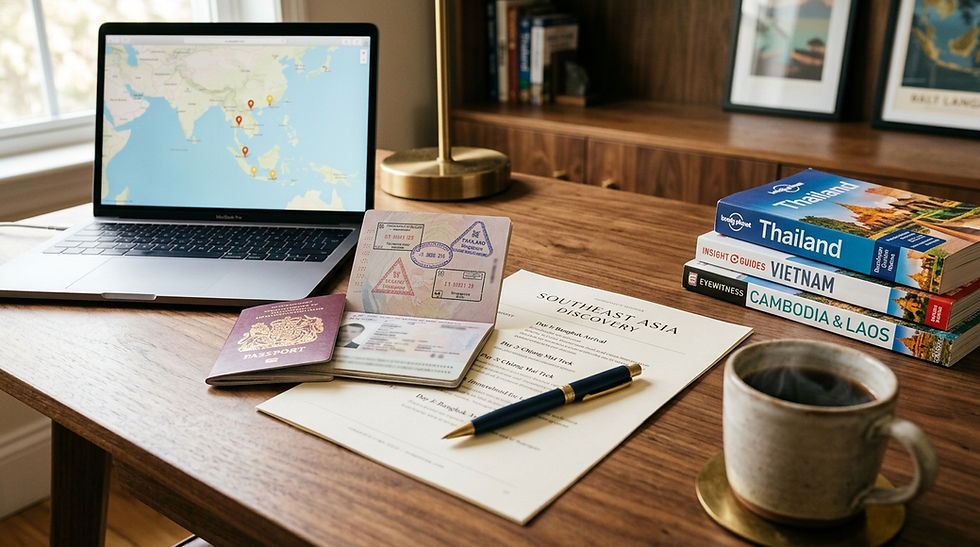
A travel advisor earns their fee on a Southeast Asia trip the moment you add a second country to the itinerary — not because Thailand, Cambodia, Laos, and Bali are individually hard to visit, but because each one runs on a different visa system, a different currency, different entry paperwork, and, right now, a different set of physical realities at the border. Case in point: if your plan involves crossing overland from Thailand into Cambodia, that plan doesn't currently work. Every official land crossing between the two countries has been closed since mid-2025, with no announced date for when that changes. A lot of the "how to cross into Cambodia at Poipet" content still floating around online was written before that happened. (Quick note on currency: Thai baht trades at roughly 32-34 to the US dollar as of this writing; every price below is quoted in USD for consistency, since USD is also the practical currency for most Cambodia and Laos border fees.)
Zensseys exists for exactly this kind of moving target — the parts of a multi-country trip that were true last year and aren't anymore.
The Overland Route Most Blogs Still Recommend Doesn't Work Right Now
For close to two decades, the standard budget-and-mid-range way to combine Thailand and Cambodia was the land crossing at Poipet-Aranyaprathet — a bus from Bangkok, a walk across the border, a Cambodia visa issued on the spot, and a connecting ride to Siem Reap. Plenty of well-ranked guides still describe it that way in detail, right down to warnings about the old "health check" scam and the visa-assistance touts who used to work the queue.
None of that logistics advice applies at the moment. Thailand shut every one of its land border crossings with Cambodia — Poipet included — after fighting broke out along the frontier in mid-2025, and both governments have said the closures stay in place until conditions on their own side are met. A ceasefire signed in late December 2025 broke down within about two weeks, and as of late summer 2026 the checkpoints remain shut with no reopening date attached. Cross-border bus operators that used to run Bangkok-to-Siem Reap coaches have suspended those routes entirely.
Zensseys Tip: If an itinerary you're looking at — from a blog, a template, or even a well-meaning friend's old trip report — routes you overland between Thailand and Cambodia, treat it as outdated until you've confirmed the specific crossing is actually operating. This status has changed more than once in the past year and could shift again with little warning.
What Actually Changes When Cambodia Joins a Thailand Itinerary Right Now
The workaround is simple in concept and easy to get wrong in practice: fly between the two countries instead of crossing overland. Bangkok connects to both Phnom Penh and Siem Reap-Angkor by air, and flights are running normally even while the land border sits closed. What trips people up is everything around that swap — an extra flight typically adds somewhere in the neighborhood of $150 to $200 per person compared to what an overland bus ticket used to cost, and it reshapes an itinerary that was built assuming a slower overland day with border-town stops along the way.
Cambodia's own entry paperwork adds a second layer. Most US travelers now use the e-visa (around $36 including the processing fee, versus about $30 for a visa on arrival) and, separately, a mandatory e-Arrival Card that replaced the old paper immigration and customs forms. Both need to be sorted before landing, not after — the old land-border habit of "get the visa when you cross" doesn't apply when you're arriving by air into Phnom Penh or Siem Reap.
There's also a safety-advisory layer worth knowing about even if your actual itinerary never goes near it. Governments including the US and UK maintain do-not-travel guidance for a band of territory along the Thailand-Cambodia frontier — roughly 50 kilometers on the US advisory, tighter on others — covering Thai provinces like Sa Kaeo, Surin, and Chanthaburi. None of that touches Phnom Penh, Siem Reap, or the southern coast, but it does rule out the border-temple day trips that used to be a common add-on to a Bangkok-based Thailand itinerary.
Zensseys Tip: Once you're already flying Bangkok to Siem Reap instead of busing it, it's worth checking whether flying into Siem Reap directly from home — skipping a Bangkok routing entirely — works out cheaper or faster for your specific dates. The math changes trip to trip.
Long-haul travelers making this exact swap — a Thailand base with an Angkor Wat side trip added by air instead of land — increasingly end up with a longer flight day than the original itinerary budgeted for; a Bose QuietComfort headphones set earns its keep on the added air time.
Laos Runs on Its Own System — Unaffected by the Cambodia Situation, but Not Simple Either
None of the Thailand-Cambodia border news touches Laos. The Thai-Lao Friendship Bridge and the other standard crossings are operating normally, and Laos remains genuinely easy to fold into a Thailand-based trip either overland or by air.
That doesn't mean it's paperwork-free. Most US travelers need a Laos visa on arrival, and the fee is quoted anywhere from about $35 to $42 depending on nationality and, oddly enough, on whether you pay in US dollars or Thai baht — paying in baht at a land crossing routinely works out a few dollars more expensive than paying in cash USD. Bring a passport photo and exact change if you can; immigration windows at land crossings don't always have change on hand, and being off by even a few dollars can slow down the whole line.
Digital arrival cards are becoming more common region-wide, which is part of why Vietnam's e-visa rules are worth understanding even if Vietnam isn't on your specific route — the pattern of "apply online, then also complete a separate digital arrival form" is spreading across Southeast Asia country by country, and each one implements it slightly differently.
Zensseys Tip: If your route touches three or four visa-on-arrival countries back to back, carry more small-denomination, undamaged US bills than you think you'll need. Torn, heavily worn, or marked bills get rejected at immigration windows in this region more often than travelers expect.
Losing track of which passport stamp goes with which country gets old fast on a four-country trip — a Royce Leather passport holder and travel wallet set at least keeps the physical documents organized while the digital ones live on your phone.
Bali Isn't Part of the Same Puzzle at All
If Bali or elsewhere in Indonesia is the third or fourth stop, it's worth knowing upfront that it doesn't share any of the above. Indonesia runs its own visa-on-arrival/e-VOA system, its own currency (the rupiah, not the US dollar that Cambodia effectively runs on), and its own entry documentation, including proof-of-funds and return-ticket requirements that Bali has tightened in recent years. None of the Thailand-Cambodia border situation reaches it.
What Bali does have is Nyepi, the Day of Silence, when the island shuts down internet access for residents and, in many cases, hotel guests too — a detail that surprises travelers who assumed "island time" just meant a slower pace, not an actual internet blackout window built into the calendar. If a multi-country itinerary happens to land on Bali during Nyepi, that's worth knowing well before departure, not on the ground.
Choosing a base matters too — Uluwatu or Seminyak end up feeling like different trips depending on whether the rest of the itinerary is temple-and-culture-heavy (Cambodia, Laos) or beach-and-nightlife-heavy.
Zensseys Tip: Pack for climate control, not just for tropical weather — Bali's coastal heat, Laos's cooler northern evenings, and Cambodia's dry-season dust are three different micro-climates inside one suitcase. An anti-theft RFID crossbody bag is a small add that pulls double duty across all three countries' more crowded market areas.
What a Travel Advisor Is Actually Doing on a Trip Like This
None of the information above is exotic — it's spread across a dozen different government advisory pages, embassy sites, and outdated blog posts that may or may not still be accurate. The actual value of working with a travel advisor on a four-country trip isn't secret knowledge; it's someone whose job is to track all of it at once, catch the parts that changed since you last looked, and build the itinerary around the version of reality that's true on your travel dates, not last year's.
That's the specific difference between why using a travel advisor pays off in general and why it pays off even more on a route like this one — a single-country Thailand trip has a much smaller set of things that can quietly go stale between the day you start planning and the day you fly. A four-country trip multiplies that risk by four, plus every connection between them.
If price is the hesitation, it's worth seeing what a real multi-city Thailand itinerary costs when Zensseys plans it before assuming a travel advisor adds cost rather than removing wasted spend — a rebooked flight because an itinerary assumed a border crossing that no longer exists costs far more than the planning fee that would have caught it in the first place.
Zensseys Tip: Ask any travel advisor you're considering one direct question before booking: "Is the Thailand-Cambodia land border currently open?" If they don't know the current answer without having to look it up on the spot, that's a useful signal about how current their information actually is. Here's how to actually find a travel advisor you can trust with a route this complicated.
Verdict
A Thailand-only trip is forgiving of a little outdated advice. A Thailand-Cambodia-Laos-Bali trip usually isn't, because the failure points compound — a wrong assumption about one border can knock the timing loose on everything booked after it. Southeast Asia rewards specialists on multi-country routes precisely because so much of what makes them work is a moving target: which land borders are open this month, which digital arrival form a given country just added, and which travel advisories currently apply to which provinces.
Zensseys is a service-disabled veteran-owned advisory built around exactly this kind of multi-country Southeast Asia planning, with current, on-the-ground knowledge of Thailand specifically, plus the connecting logistics into Cambodia, Laos, and Indonesia/Bali. A free consultation is the fastest way to find out whether a planned route is even still physically possible as designed, and full trip planning and booking covers everything from there — visas, flights, border-status monitoring, and a pivot plan if something changes between booking and departure. Because rules like the Thailand-Cambodia border status can shift again with little notice, it's worth staying ahead of them — subscribe for updates whenever something like this changes. For a Thailand-specific starting point, William Harris and the Zensseys team can also be reached directly at (210) 239-7540.
FAQ
Is the Thailand-Cambodia land border open right now? No. As of this writing, every official land crossing between Thailand and Cambodia — including the busy Poipet-Aranyaprathet route — has been closed since mid-2025, with no announced reopening date. Confirm current status before finalizing any overland plans, since this has shifted more than once already.
Can I still visit both Thailand and Cambodia on the same trip? Yes — you'll just need to fly between them (Bangkok to Phnom Penh or Siem Reap-Angkor are the standard routes) instead of crossing overland, which adds roughly $150 to $200 per person versus the old bus-ticket cost, plus a bit more planning around flight schedules.
Do Thailand, Cambodia, Laos, and Bali all use the same visa process? No — each runs its own system. Cambodia uses an e-visa (around $36) or visa on arrival (around $30) plus a mandatory e-Arrival Card; Laos uses a visa on arrival typically priced $35 to $42 depending on nationality and payment currency; Indonesia/Bali has its own e-VOA system with separate proof-of-funds and return-ticket requirements.
Does the Thailand-Cambodia border situation affect travel to Laos or Bali? No. The land border closures and travel advisories are specific to the Thailand-Cambodia frontier. The Thai-Lao border crossings and all Indonesia/Bali travel are unaffected and operating normally.
How far in advance should a multi-country Southeast Asia trip be planned with a travel advisor? There's no hard rule, but earlier is better when a route touches three or four countries with different visa timelines — some e-visas process in a few days, others need more lead time, and flight pricing between regional cities tends to firm up, and rise, as dates get closer.
About the Author
William Harris is the founder and lead travel advisor at Zensseys, a service-disabled veteran-owned luxury travel advisory specializing in Thailand, Vietnam, Indonesia/Bali, and the Philippines. Reach William directly at (210) 239-7540, or meet the team to start planning.




Comments