


Does TM30 Actually Affect Hotel Guests in Thailand, or Only Long-Stay Renters?
The Short Answer
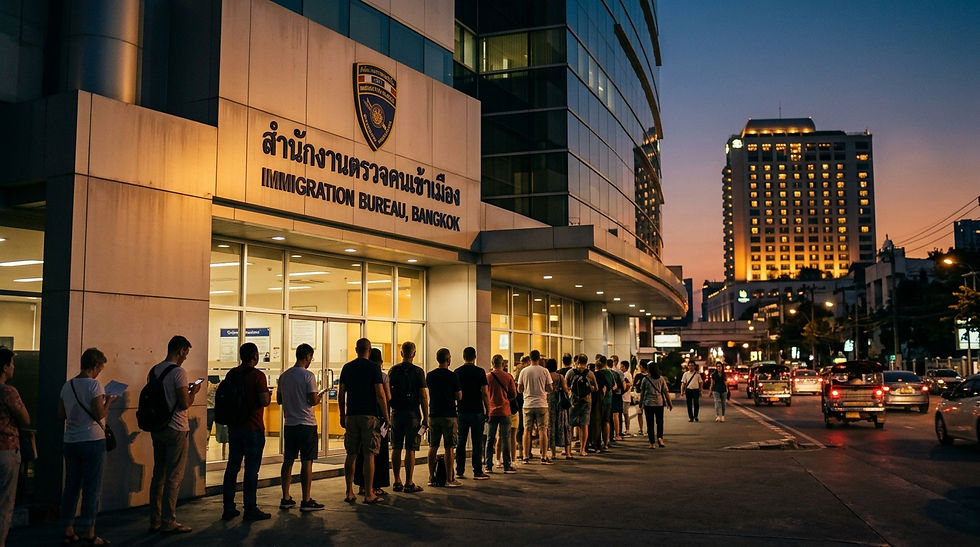
If you're staying in a hotel in Thailand, TM30 is not your problem — the hotel files it electronically the moment you check in, and you will likely never see it happen. TM30 only becomes something you personally have to think about if you're renting a condo, villa, or Airbnb-style unit on a longer visa (DTV, retirement, education, or marriage extension), where the reporting duty legally sits with your landlord but the consequences land on you if they skip it.
What TM30 Actually Is (And Why It Confuses Almost Everyone)
TM30 is Thailand's foreigner address-reporting requirement, written into Section 38 of the 1979 Immigration Act. It requires whoever owns or manages the property you're sleeping in — a hotel, a condo owner, a house-master, a guesthouse manager — to notify local immigration within 24 hours of your arrival. The law has existed since 1979, but it sat almost unused for decades before a 2019 enforcement push turned it into one of the most argued-about rules among Thailand's expat community.
Here's the part that trips up almost every article written about it: TM30 was never designed around tourists in hotels. It was designed around tracking where foreigners physically sleep, full stop. Hotels have simply always had the infrastructure to comply instantly, because checking a passport at the front desk was already part of hotel operations before TM30 existed. Long-stay renters, on the other hand, depend on a private landlord who may have never heard of the form, may not want to deal with it, or may not legally be allowed to file it if the condo isn't properly registered.
Zensseys Tip: If you're extending a visa or filing a 90-day report anywhere in Thailand, immigration officers can and do ask for your TM30 receipt as supporting proof of address. Losing it isn't the end of the world — you file a police report and request a reissue — but it adds a wasted morning to a process that should take twenty minutes. A slim Royce Leather passport holder and travel wallet set is worth packing specifically to keep that receipt from disappearing into the bottom of a bag.
Why Hotel Guests Almost Never Notice TM30 Happening
Every legally licensed hotel in Thailand is connected directly to the Immigration Bureau's database. When the front desk scans your passport at check-in, that scan does double duty: it satisfies the hotel's own guest-registration requirement and files your TM30 in the same motion. You never fill out a form, never sign anything TM30-specific, and never interact with immigration directly. This is the single biggest reason the "TM30 crackdown" headlines you've probably seen don't actually apply to a typical two-week hotel-based trip through Bangkok, Phuket, or Chiang Mai.
The confusion happens because TM30 news coverage is almost entirely written for and about long-term foreign residents — retirees, remote workers on a DTV visa, people building a life in Chiang Mai or Hua Hin — not vacationers. A traveler skimming a headline about "TM30 fines" understandably assumes it's a personal risk on their upcoming trip, when in reality the exposure sits almost entirely with whoever holds the lease.
Where TM30 Actually Becomes Your Problem
The picture changes the moment you're not in a hotel. If you book a private condo, a villa through a boutique rental agency, or an extended Airbnb-style stay — increasingly common for DTV visa holders and long-stay retirees — the reporting duty falls on the property owner or manager, not on the platform and not automatically on you. Renters in this position should ask the landlord for the TM30 receipt before signing anything, since a landlord who's never heard of the requirement will cost time later, not now.
The financial penalty for non-filing is modest on paper — 800 to 2,000 baht (roughly $26 to $65 USD at current exchange rates near 31 baht to the dollar) — and it technically falls on the property owner, not the guest. In practice, that distinction blurs fast. If your visa extension or 90-day report gets held up because your landlord skipped the filing, you're the one standing in the immigration office losing a morning, even though you never owed the fine yourself.
Zensseys Tip: Enforcement intensity is genuinely inconsistent office to office and year to year — what one Bangkok immigration office waves through, a stricter provincial office two hours away will flag. If you're mid-DTV visa or planning a multi-city Thailand stay that mixes hotels and a rented condo, this is exactly the kind of coordination Zensseys handles so you're not the one discovering the gap at the immigration counter.
The Re-Filing Trap Almost Nobody Warns You About
The single most common TM30 mistake among long-stay travelers isn't the initial filing — it's forgetting that a fresh filing is technically required after every international departure and return, even to the exact same address you've lived at for years. Take a weekend trip to Cambodia or Laos and come back, and the clock resets. Some immigration offices have quietly relaxed this for returning residents at a previously registered address; others treat every re-entry as a brand-new arrival requiring a brand-new TM30 within 24 hours. Neither position is guaranteed, and the rule can tighten again without much public notice — it has already flexed both directions multiple times since the 2019 enforcement push began. Long-term residents in one province will swear the relaxed version is standard while residents two hours away are still re-filing after every trip, and both are describing their own immigration office accurately.
This matters directly for anyone doing a multi-country Southeast Asia loop that treats Thailand as a home base — Bangkok, out to Vietnam or Cambodia for a week, back to the same Bangkok condo. On a hotel-based itinerary this is a non-issue since the hotel refiles automatically every stay. On a rented-condo itinerary, it's exactly the kind of detail that turns into an unpleasant surprise at a 90-day report six weeks later. An anti-theft RFID crossbody bag is a small, practical add for carrying your passport and TM30 paperwork on immigration-office runs in cities where pickpocketing near government buildings is a known issue.
For travelers weighing the logistics of a longer Thailand stay against a tighter hotel-hopping trip, the Thailand Ocean Itinerary guide walks through sequencing multiple regions without the address-reporting headache that comes with settling into one rented base.
Why This Is Getting Stricter, Not Looser
Thailand's immigration enforcement has been visibly tightening across several fronts at once — not just TM30, but the DTV visa's new documentation requirements and a fast-tracked deportation law aimed at foreigners deemed to be behaving "immorally," both signs of a broader push toward tighter tracking of who's actually in the country and on what basis. A 2026 joint task force sweep in Chiang Mai specifically flagged stricter TM30 enforcement alongside hotel-licensing and nominee-business crackdowns, and industry observers now openly say what was loosely enforced one year can become strictly enforced the next with little warning. None of that changes the hotel-guest reality above, but it does mean long-stay renters should treat TM30 compliance as a genuine priority rather than expat-forum paranoia.
Complicating things further, Thailand's Digital Arrival Card, which replaced the old paper TM6 form in 2025, does not satisfy anyone's Section 38 obligation — filling out your arrival card and having your TM30 filed are two completely separate systems that happen to both involve immigration paperwork. Travelers who assume one covers the other are the ones most likely to get caught out. Sorting through which requirement applies to which part of your trip is exactly the kind of thing worth flagging to a travel advisor before you land, not after.
The Verdict
For the overwhelming majority of Zensseys clients — travelers building a hotel-based Thailand or multi-country Southeast Asia trip — TM30 is a non-event. The hotel handles it, you never see it, and the only thing worth knowing is that the requirement exists so the "TM30 crackdown" headlines don't rattle you mid-trip. The calculation flips entirely if you're extending into a longer stay on a DTV visa, retirement extension, or rented condo: at that point, TM30 compliance becomes a real administrative dependency on a landlord you should vet before you sign anything. If your plans blend both — hotel stays in some cities, a longer rented stay in another — that's precisely the kind of multi-jurisdiction detail worth a real travel consultation rather than piecing it together from expat forums. Curious travelers who want the next Thailand rule change delivered before it becomes a headline can also subscribe for updates as enforcement shifts.
FAQ
Do I need to personally file anything if I'm only staying in hotels? No. Licensed hotels file TM30 electronically at check-in as part of their standard passport-scan process. You won't sign a form or interact with immigration directly.
Can I be fined for a landlord's failure to file TM30? Not directly — the legal penalty (800–2,000 baht, roughly $26–$65 USD) falls on the property owner or manager. In practice, an unfiled TM30 can delay your own visa extension or 90-day report, costing you time even though the fine itself isn't yours.
Does the Thailand Digital Arrival Card replace TM30? No. The Digital Arrival Card (which replaced the paper TM6 in 2025) is a separate entry-processing system and does not discharge the Section 38 address-reporting duty at all.
Do I need a new TM30 every time I leave and re-enter Thailand? Technically yes, even returning to the identical address, though enforcement of this specific point varies significantly by immigration office and has flexed over time. Assume you need to re-file after any international trip unless your landlord confirms otherwise in writing.
Does TM30 apply if I'm on a 30-day visa exemption doing a short hotel-based trip? Yes in theory — the law applies to any foreigner staying anywhere in Thailand — but in practice a hotel-based trip means the hotel absorbs the entire obligation invisibly. You're only exposed if you shift to a private rental.
If you want the fuller picture of how Thailand's tightening immigration enforcement fits together — TM30, the DTV visa's new requirements, and the broader crackdown — this breakdown is a useful primer before your next trip:
About the Author
William Harris is the founder and lead travel advisor at Zensseys, a service-disabled veteran-owned luxury travel advisory specializing in Thailand, Vietnam, Indonesia/Bali, and the Philippines. He personally untangles the visa, documentation, and address-reporting details that trip up multi-country Southeast Asia itineraries, so you don't find out about a gap at the immigration counter. Reach him directly at (210) 239-7540, book a free consultation, or go straight to full trip planning and booking for $199. Read more on the Meet William page, or explore the Thailand travel services page for destination-specific planning help.




Comments