

Wildlife You Can Get This Close to in Thailand (And Why You Never Could Back Home)
Ask a hundred travelers what they remember most from Thailand, and a surprising number won't mention a temple or a beach. They'll mention an elephant's trunk searching their pocket for bananas, a five-foot lizard strolling past their morning coffee, or a wild monkey stealing a pair of sunglasses right off their face.
Thailand's wildlife doesn't stay behind glass. Much of it lives in the same parks, canals, and forests where you're walking, and the rules that govern how close you can get are worlds apart from what US law, liability, and geography allow back home. Here's what's actually out there, what it's like to encounter it, and where the line between 'incredible experience' and 'bad idea' sits.
What wildlife can you actually get close to in Thailand?
In Thailand, travelers can bathe and feed rescued elephants at ethical sanctuaries, walk past free-roaming water monitor lizards in Bangkok's city parks, watch wild long-tailed macaques at open-air temples, and snorkel beside whale sharks in open water. These are legal, common experiences that US wildlife law, zoo liability rules, and simple geography generally don't allow.

Asian Elephants: Bathing and Feeding Rescued Giants
Thailand is home to roughly 3,000 domesticated elephants, and a growing number of sanctuaries let visitors feed, walk beside, and bathe them in a river or mud pool. At places like Elephant Nature Park in Chiang Mai or Phuket Elephant Sanctuary, there's no riding and no chains. You mix fruit into feeding balls, scrub an elephant's back while it sprays you with water, and hear a mahout explain the animal's history, often one of logging work or street begging before rescue.
None of that happens at a US zoo. Accredited American facilities keep elephants behind protected contact barriers for insurance and safety reasons; the public doesn't touch, feed, or bathe them, and there's no equivalent of a river-bathing afternoon anywhere in the country.
Zensseys Tip: "Sanctuary" isn't a protected word in Thailand, and some operators still offer riding or shows behind that label. Look for a place that explicitly bans riding and chaining, limits group sizes, and lets elephants set their own pace rather than performing on cue.
One Tripadvisor reviewer who visited a lower-tier park put it bluntly: "This place is NOT a sanctuary—it's a business built on the suffering" of the elephants involved. Reading recent reviews before booking is the single best filter you have.
A GoPro Hero action camera is worth packing for this one specifically. Your hands will be full of banana and mud, and a chest or head mount captures the bath-time chaos without you fumbling for a phone.

Water Monitor Lizards: City Wildlife With Free Rein
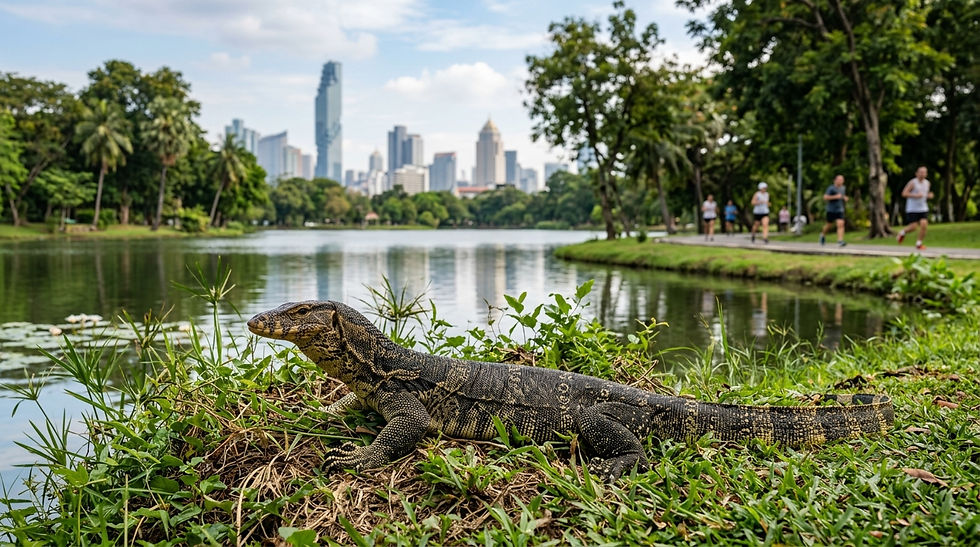
Bangkok's Lumpini Park is home to hundreds of Asian water monitors, some stretching past six feet, wandering the lawns and canals alongside joggers and picnickers. They're not exhibits. Nobody feeds them on a schedule or manages their movements; they simply live there, the way pigeons live in a city square, and have for decades.
Nothing in the US operates this way. A six-foot reptile loose in a downtown park, say an alligator in a Florida city green space, gets caught and relocated by animal control within hours. Letting one roam freely among visitors would be a liability nobody would accept.
One Google reviewer summed up the local attitude well: "BEWARE of land monitor lizards as they are sneaky and super quiet", a fair warning, though in practice they rarely bother anyone who keeps a respectful distance and doesn't feed them.
Zensseys Tip: Watch, don't feed. Monitor lizards that associate people with food get bolder and more likely to approach; keep at least a few meters of space and never offer them anything from your hand.
Long-Tailed Macaques: Temple Troops You Can Walk Among
Lopburi's so-called Monkey City, along with temple grounds near Krabi's Railay Beach and the Big Buddha in Phuket, are home to wild macaque troops that live openly among visitors, no fence, no keeper, no distance requirement. You can watch them groom, squabble, and raid unattended bags from a few feet away.
US national parks take the opposite approach on purpose. The National Park Service asks visitors to stay at least 25 yards from most wildlife, feeding any wild animal is a federal offense, and rangers actively enforce both. Thailand's temple macaques operate under no such buffer, which is exactly why they've become comfortable enough to sit a few feet from a stranger's lunch.
That comfort cuts both ways. A widely reported incident in Krabi involved a group of macaques swarming and biting a tourist after a baby monkey climbed onto her head, a reminder that these are wild animals, not photo props. Bites and scratches from monkeys account for a meaningful share of rabies post-exposure treatment among travelers to Thailand, second only to dog bites.
Zensseys Tip: Keep bags zipped and food out of sight, never smile with bared teeth at a macaque (they read it as a threat display), and don't let anyone in your group let a monkey climb onto them for a photo. If a bite or scratch happens, wash it immediately and get evaluated the same day; don't wait to see if it feels fine.
Read up on local temple etiquette before you go, since the same trip that puts you near wild monkeys usually puts you inside active places of worship too, and our guide to Thailand's biggest cultural taboos covers what to know before you step through a temple gate.
An anti-theft RFID crossbody bag keeps zippers away from curious hands, and a compact travel first aid kit means you can clean a scratch on the spot instead of hunting for a pharmacy.
White-Handed Gibbons: A Protected Species You'll Mostly Hear
Gibbons are Thailand's early-morning soundtrack in places like Khao Yai National Park, where their whooping duets carry through the canopy at dawn. Seeing one swing overhead is a matter of luck and patience, but rescue and rehabilitation centers, most working to reintroduce gibbons pulled from the illegal pet trade, let visitors observe them up close under professional supervision.
In the US, gibbons don't exist in the wild at all, and owning one privately is illegal in nearly every state. The only legal access is through an accredited zoo, and even there, contact is strictly keeper-only. Hearing a wild gibbon call at sunrise simply isn't an experience the US can offer, regardless of budget or connections.
Khao Yai is an easy add-on if you're already planning time around Bangkok, and our guide to national parks worth a day trip from Bangkok breaks down logistics, timing, and what else to expect once you're there.
A pair of Nocs Provisions compact binoculars earns its space in your bag here. Gibbons stay high in the canopy, and a lightweight pair beats squinting through a phone zoom every time.
Whale Sharks and Reef Life: Swimming Beside the Ocean's Biggest Fish
Whale sharks pass through Thai waters near Koh Tao and the Similan Islands on a fairly predictable seasonal basis, and licensed dive and snorkel operators run trips that put you in open water a few meters from a filter-feeding giant that can stretch over 30 feet. It's gentle, legal, and one of the more surreal things you can do on a beach vacation.
US federal rules make the equivalent much harder to arrange. Approaching protected marine species too closely in US waters can violate NOAA regulations, and mandated minimum distances exist for whales, dolphins, and other protected animals in a way that simply doesn't apply to a Thai dive boat pulling up on a whale shark sighting.
Zensseys Tip: Go with an operator that briefs you on hands-off etiquette (no touching, no chasing, no flash photography) before you're in the water. A whale shark that feels crowded will simply dive and end the encounter for everyone.
King Cobras and Snake Encounters: Where 'Close' Has a Line
Thailand is home to the king cobra, the world's longest venomous snake, along with reticulated pythons and dozens of other species you'll occasionally spot in canals, rice fields, and even Bangkok's parks. Bangkok's Queen Saovabha Memorial Institute, a research-driven snake farm connected to the Thai Red Cross, runs public venom-milking demonstrations that double as genuine antivenom research, not just tourist entertainment.
That's a meaningfully different experience from the roadside "snake shows" that still exist around some tourist areas, where animals are handled roughly for photos. There's no real US equivalent to either version. Public venomous-snake handling demonstrations are rare stateside, largely due to liability, so this is genuinely a Thailand-only encounter, provided you pick the research institution over the roadside show.
Thailand vs. the US: A Quick Reference
Elephants: hands-on bathing and feeding at Thai sanctuaries → protected-contact only, no public touching, at US zoos
Water monitors: free-roaming through Bangkok's city parks → comparable reptiles caught and relocated by US animal control
Temple macaques: wild troops a few feet away, no barrier → 25-yard minimum distance enforced in US national parks
Gibbons: wild dawn calls and supervised rehab-center visits → zoo-only, keeper-contact exotic species in the US; private ownership largely illegal
Whale sharks: guided open-water swims a few meters away → federal minimum-approach distances for protected marine species in US waters

Frequently Asked Questions
Is it safe to be around wild monkeys in Thailand?
Generally yes if you keep food hidden and don't invite contact, but macaques are wild animals capable of biting or scratching, especially around food or when a baby monkey is involved. Treat every troop as unpredictable rather than tame.
Are Thailand's elephant sanctuaries actually ethical?
Some are and some aren't. "Sanctuary" isn't a regulated term, so check for a no-riding, no-chaining policy, read recent reviews, and favor places affiliated with known rescue organizations rather than booking the first tour a hotel desk recommends.
Do I need a rabies vaccine before visiting Thailand?
Talk to a travel health provider about it, especially if you'll be near temples, markets, or national parks. The CDC's Thailand travel health page and its rabies guidance outline current recommendations, and pre-exposure vaccination buys you more time to reach care if a bite or scratch does happen.
Which of these would you actually try? Elephant bath, whale shark swim, or a wide berth around the monitor lizards, drop a comment and let us know, and follow along for more of Thailand's wilder side.
None of this replaces good judgment. Wild is wild, whether it's wearing scales, fur, or a saffron-colored temple backdrop, and the same animals that make Thailand's wildlife scene so accessible can turn unpredictable in a second. If you want a itinerary built around responsible wildlife encounters, from ethical elephant time to a Khao Yai gibbon morning, a Zensseys Travel Consultation puts a real Southeast Asia specialist behind the planning instead of a generic packing list.
About the Author
Zensseys was founded by William Harris, a veteran and lifelong traveler who has explored destinations across the U.S., Europe, the Middle East, and Asia. Every recommendation here is backed by real travel experience and a genuine passion for helping others travel with less stress and more excitement. Meet William.
Travel More, Discover More.
Here's a closer look at a Thailand elephant sanctuary visit, filmed honestly, riding and all-day chains not included:




Comments