


Balinese Purification Rituals Beyond Melukat: Understanding Bali's Spiritual Traditions
Most travelers who've done any research on Bali know the word melukat — the water purification ceremony that's become almost synonymous with the island's spiritual reputation. What most guides don't mention is that melukat is one thread in a much larger fabric. Purification runs through nearly every layer of Balinese life: the objects in a temple, the ground beneath a village, the soul of a teenager becoming an adult, and the entire island itself, once a year, all at once. Understanding that bigger picture changes how you experience Bali, whether or not you ever set foot in a holy spring.

What Purification Rituals Exist in Balinese Culture Beyond Melukat?
Balinese Hinduism includes purification rituals for places, communities, and life stages, not just individuals. Key examples include Melasti (purifying sacred temple objects in the sea), Tawur Kesanga and the Ogoh-Ogoh parade (purifying the island of negative energy before the new year), Nyepi itself (a full day of stillness as collective self-purification), and Metatah, a tooth-filing rite of passage that symbolically purifies a person of six negative traits.
The Philosophy Underneath All of It
To understand why Bali has so many distinct purification rituals, it helps to understand the worldview behind them. Balinese Hinduism is built around Tri Hita Karana — the belief that wellbeing depends on harmony in three relationships at once: with the divine, with nature, and with other people. When any of those relationships fall out of balance, the result is mala, spiritual impurity, and life exists across two connected realms known as sekala (the seen world) and niskala (the unseen world) that purification rituals work to keep aligned.
That's why purification in Bali isn't a single practice — it's a category of practices, each addressing a different kind of imbalance, at a different scale.
Purifying Place: The Melasti Ceremony
A few days before Nyepi each year, processions of Balinese worshippers dressed in white walk to the sea carrying sacred temple objects — statues and ceremonial items known as Arca, Pratima, and Pralingga. This is Melasti, and its purpose is to cleanse those objects using Tirta Amerta, “the water of life,” collected from the ocean. It's considered one of the most visually striking ceremonies on the Balinese calendar, and it's open for visitors to witness respectfully from a distance.
Zensseys Tip: If you're in Bali during Melasti, the seaside temples (Pura Segara) draw large processions — arrive early, stay well back from the ceremony itself, and treat it the way you would a funeral procession passing through a town square: present, respectful, and not in the way. A pair of Ray-Ban or Maui Jim Polarized Sunglasses earns its keep here too — Melasti processions often run through an hour or more of open beach light, and you'll be standing and watching, not swimming.

Purifying the Island: Tawur Kesanga and the Ogoh-Ogoh Parade
The night before Nyepi, Bali performs one of its most dramatic rituals. Villages spend weeks building enormous, elaborately sculpted effigies called ogoh-ogoh — often ten to twenty feet tall — representing Bhuta Kala, the negative and destructive forces Balinese Hindus believe accumulate over the year. During the Tawur Kesanga ceremony, offerings called pecaruan are made to appease these forces, and then the ogoh-ogoh are paraded through the streets with gamelan music, fire, and noise before being ceremonially burned — a symbolic purification of the entire island before the new year begins.
Tourists are genuinely welcome to watch. Visitors are permitted to take photos and videos of the parade in a respectful manner, and it's considered one of the most exciting cultural spectacles in Bali. The etiquette is straightforward: dress modestly, don't block the procession route, and never touch the effigies — they're sacred objects mid-ritual, not photo props.
Zensseys Tip: Road closures typically start mid-afternoon ahead of the parade, and most restaurants close early so staff can get home in time. If you want dinner beforehand, eat early — not after the parade. If you want a closer look at the carving detail without pushing into the crowd, a pair of Nocs Provisions compact binoculars lets you watch from exactly the respectful distance the moment calls for.
A GoPro Hero action camera is also worth having on hand for a parade like this — a good zoom and a steady hand let you document the spectacle properly without needing to get close enough to be intrusive.
Nyepi Itself: The Ultimate Act of Purification
Nyepi, the Day of Silence, is the purification ritual that swallows every other one whole. For 24 hours, the entire island stops. The airport closes. Roads empty. Lights go off. Even the internet is throttled in some years. Hindus stay indoors for meditation and self-reflection, and — importantly — tourists are required to participate too, regardless of religion. As one hotel manager in Kuta put it, describing what the day means to Balinese Hindus, it's “an opportunity to restart life with a pure heart.”
This isn't a polite suggestion. Tourists have been arrested in past years for wandering around during Nyepi, and local pecalang (village security officers) actively patrol to enforce the silence. Most resorts handle this gracefully — you won't be confined to a dark room, but you will be asked to keep curtains closed, stay off the beach and streets, and skip anything loud.

Zensseys Tip: Nyepi genuinely is worth experiencing rather than avoiding. Book accommodation well ahead of the date, stock up on snacks and entertainment the day before, and treat it as one of the more unusual, memorable 24 hours you'll spend on any trip — not a travel inconvenience to work around. If you're timing a longer trip around the date, a Bose QuietComfort headphones pair makes the long-haul flight in a lot more bearable before you land into a full day of intentional stillness.
A YETI Rambler insulated bottle filled the evening before is worth adding to that stock-up list too — one less reason to open a door on a day built around staying inside.
Purifying a Person: Metatah and the Six Enemies Within
Not every purification ritual in Bali is something a traveler can witness, let alone join — and Metatah (also called Mepandes or Mesangih) is a good example of one that's private, family-centered, and worth understanding rather than seeking out. It's a coming-of-age ceremony, typically performed on teenagers, that involves filing the six upper front teeth: four incisors and two canines.
The ritual is rooted in the belief in Sad Ripu, the six inner enemies every person is born with — lust, greed, anger, drunkenness, confusion, and jealousy — symbolically embodied in those same six teeth. Filing them down is understood as a purification of character, not a cosmetic procedure, marking the transition from adolescence into adulthood.
If you happen to see a Balinese family compound decorated elaborately, with a teenager dressed in gold and traditional dress at the center of the gathering, there's a good chance you've stumbled onto a Metatah ceremony. The respectful move is the same one that applies everywhere in Bali: observe from a distance, don't intrude, and don't assume an invitation.
A Living Tradition, Not a Performance
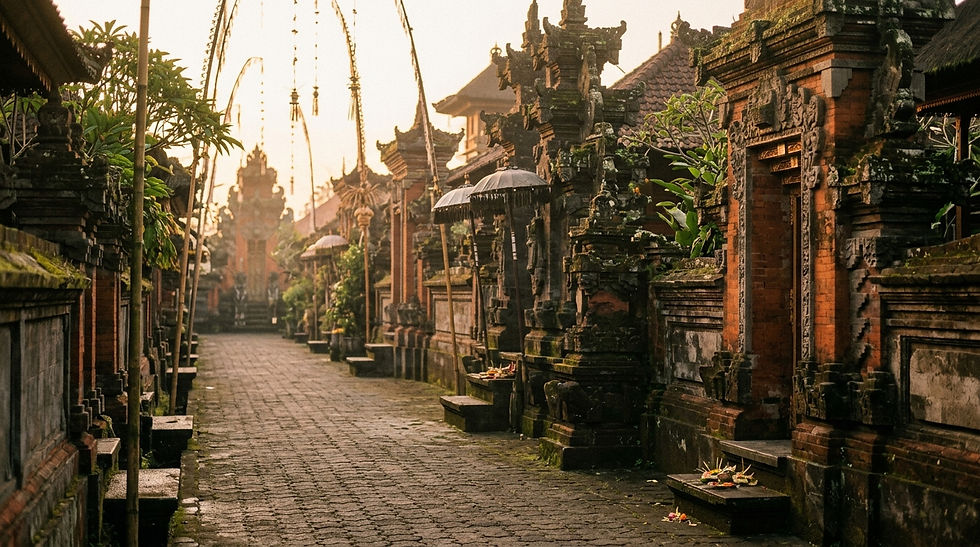
It's worth repeating something that applies across every ritual in this article: these are not shows staged for tourism. Melukat itself has tightened its own rules recently — as of April 2025, visitors must be accompanied by a licensed guide to enter Tirta Empul temple for water purification, a change aimed at protecting the ceremony's integrity as its tourist popularity has grown. That's a useful signal for every ritual described here: Bali is increasingly drawing a clearer line between what's open for respectful observation and what requires a guide, an invitation, or simply distance.
Approaching any of these traditions with genuine curiosity rather than a checklist mentality is what separates a meaningful cultural encounter from an awkward one.
If you've witnessed any of these ceremonies in person, we'd love to hear about it in the comments — it's the kind of firsthand detail that helps other travelers know what to expect.
Frequently Asked Questions
Can tourists watch the Ogoh-Ogoh parade?
Yes — it's one of the most tourist-welcoming rituals in Bali, as long as visitors stay respectful, dress modestly, and don't touch the effigies.
Do tourists have to observe Nyepi even if they're not Hindu?
Yes. Everyone on the island, regardless of religion, is required to stay off the streets and beaches for the full 24-hour period, and the rule is actively enforced.
Can visitors participate in a Metatah tooth-filing ceremony?
No — it's a private family and community rite for Balinese teenagers, not something tourists take part in. It's appropriate to observe respectfully from a distance if you encounter one, not to seek an invitation.
Is melukat still open to tourists?
Yes, but as of April 2025 visitors need a licensed guide to perform water purification at Tirta Empul specifically, a rule introduced to help preserve the ceremony's authenticity.
Zensseys Recommendation
The more of these rituals you understand before you go, the more Bali reveals itself as something deeper than a beautiful backdrop — a place where an entire culture actively, continuously works to stay in balance. Timing a trip to witness Melasti, the Ogoh-Ogoh parade, or Nyepi itself takes a bit of planning around the Balinese calendar, and that's exactly the kind of detail worth getting right. A Royce Leather passport holder is a small, fitting thing to travel with on a trip built around this much ceremony and intention — the kind of detail-oriented traveler this trip rewards tends to appreciate one elsewhere too. For help building a Bali itinerary around these traditions, visit Zensseys for more info.
Travel More, Discover More.
For a vivid, on-the-ground look at the Ogoh-Ogoh parade itself, this is worth watching:




Comments