


What Actually Counts as 'Working Illegally' on a Thailand Tourist Visa? The Remote-Work Gray Area, Explained

The Short Answer
Technically, yes — answering work emails on a laptop in a Chiang Mai cafe is, by the letter of Thai law, illegal without a work permit, and Thailand doesn't carve out an exception for remote work the way many countries with murkier immigration codes do. In practice, enforcement almost never touches someone quietly earning foreign income while visiting on a tourist visa. The real risk zone — the one that actually shows up in Thailand's new fast-track deportation categories — is Thai-sourced income, invoicing local clients, or working for a Thai employer. That distinction is the whole gray area, and it's getting narrower in 2026.
What Thai Law Actually Says
Thailand's Alien Working Act B.E. 2551 doesn't distinguish between a job that happens to be performed in Thailand and a job that's actually for a Thai company. Any work without a permit is technically prohibited, full stop — a stricter standard than most of Europe, Mexico, or Latin America, where immigration codes simply haven't caught up to remote work and enforcement occupies a genuine legal gray zone. Thailand sits alongside Indonesia and Japan as a country where the written law is unambiguous: work is work, regardless of who's paying you or where they're based.
Zensseys Tip: Don't confuse "commonly tolerated" with "technically legal." The distinction matters if you're ever asked directly by an immigration officer what you're doing in Thailand for an extended stay.
What Actually Gets Enforced vs. What Doesn't
Here's the practical reality: documented cases of tourists being penalized specifically for quietly doing their normal foreign job on a laptop are remarkably rare. Immigration enforcement in Thailand is overwhelmingly focused on people taking local jobs from Thai workers, not on someone in a Bangkok co-working space answering Slack messages for a company back home. That gap between the strict letter of the law and where enforcement actually points is exactly why so many digital nomads have operated in Thailand for years without incident — and also why it's dangerous to assume that gap will always hold.
Where the Real Risk Actually Starts
The gray area collapses the moment Thai money enters the picture. Invoicing a Thai client, accepting a "small consulting fee" from a Thai-registered company, taking a job with a local employer, or setting up an unregistered local business under the Foreign Business Act B.E. 2542 — these are the categories where enforcement gets serious, and not coincidentally, illegal work is one of the six specific categories named in Thailand's new fast-track deportation regulation that the Cabinet approved on August 2, 2026. Some 2026 guidance also suggests Thailand's digital arrival and banking systems are increasingly capable of cross-referencing local bank inflows against visa type, though how consistently that's applied in practice isn't something we'd stake a trip on.
Zensseys Tip: If you're doing genuinely foreign-sourced remote work, keep your paper trail clean: a real employment letter or client contract, and avoid receiving any payment from a Thai-registered entity into a Thai bank account, however small.
The Legal Pathway: Destination Thailand Visa (DTV)
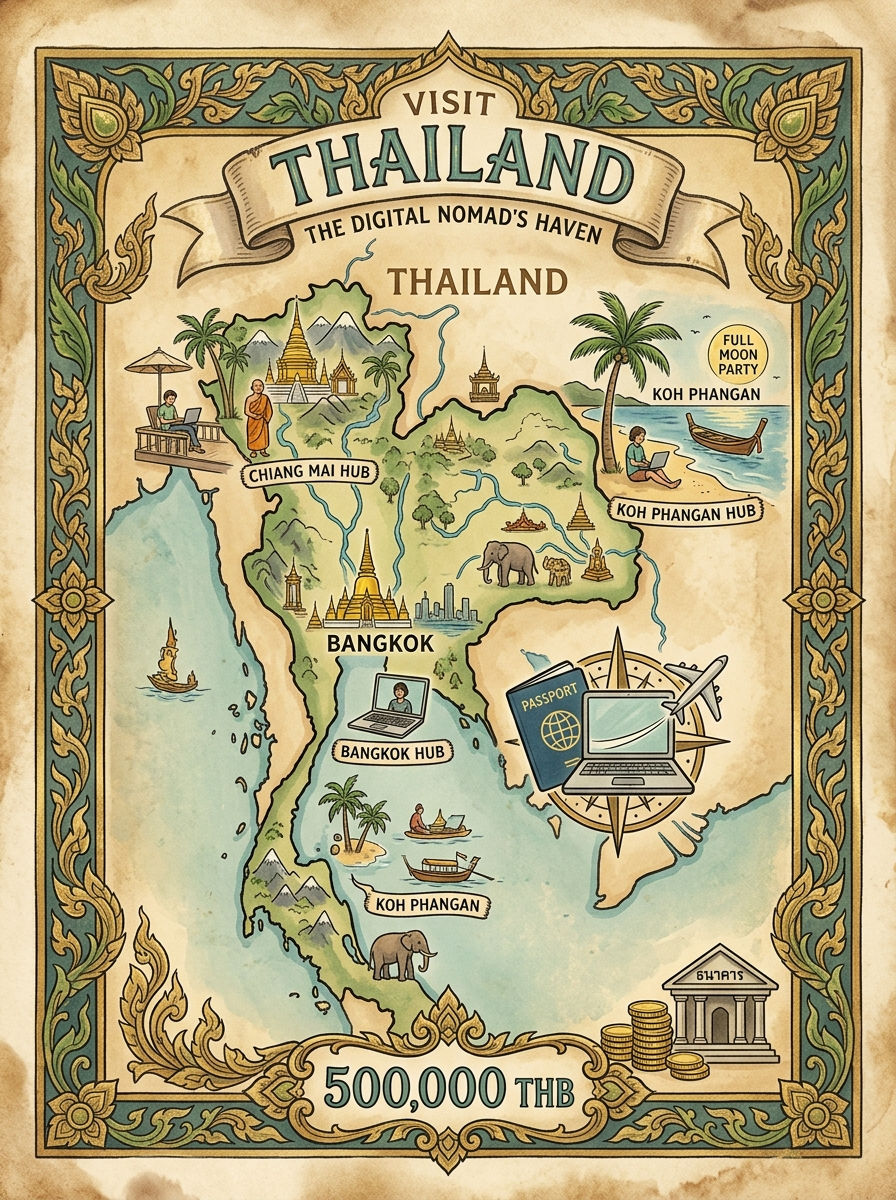
If you're planning to stay longer than a typical vacation, Thailand's Destination Thailand Visa closes the gray area entirely for foreign-sourced remote work. It's a five-year, multiple-entry visa granting 180 days per entry, extendable once to 360 days, and it requires roughly 500,000 THB (about $14,500 USD) held in savings for three to six months before applying. The catch that trips people up: the DTV legalizes remote work for a foreign employer or foreign clients, but it explicitly still prohibits working for a Thai company or earning Thai-sourced income — the DTV solves the "am I allowed to be here doing this" problem, not the "can I take local clients" problem, which still requires a Non-Immigrant B visa and a proper work permit.
The Tax Question Nobody Wants to Deal With
Staying in Thailand 180 days or more within a calendar year generally makes you a Thai tax resident, which can trigger Thai tax obligations on foreign income remitted into the country, separate entirely from whatever you owe your home country. This is genuinely complicated, varies by nationality and specific circumstances, and isn't something to sort out after the fact — we're a travel advisory, not a tax firm, so this is a good moment to loop in an actual cross-border tax professional if you're approaching that threshold.
Working From Thailand, Practically Speaking
If you're setting up shop in a co-working space or hotel room for weeks at a time, the basics still matter: a reliable Bose QuietComfort headphones setup makes video calls bearable over a hotel Wi-Fi connection, and a compact travel power strip with USB ports solves the near-universal problem of Thai hotel rooms never having quite enough outlets near the desk.
The Verdict
If your Thailand trip involves working quietly on your own laptop for a company or clients based outside the country, the practical risk is low but not zero, and it's been trending toward "not zero" faster in 2026 than in previous years. If you're staying long enough that the math starts to matter — three months, six months, a full year — the DTV removes the ambiguity entirely for a modest cost, and it's worth sorting out before you land rather than after. A Zensseys Travel Consultation is a good place to start if you're weighing a longer Thailand stay against the visa options actually available to you.
Frequently Asked Questions
Is it illegal to answer work emails on my laptop while on vacation in Thailand?
Technically yes, under the strict letter of Thai law, but enforcement against tourists doing quiet, foreign-sourced remote work is genuinely rare. The real enforcement focus is on people taking local jobs or earning Thai-sourced income.
What's the difference between working remotely and "working illegally" in Thailand?
The practical dividing line is where the money comes from. Foreign-sourced income while quietly working on a tourist visa is a low-enforcement gray area. Thai-sourced income, invoicing local clients, or working for a Thai employer is the genuine risk zone, and it's one of the categories named in Thailand's newest fast-track deportation rules.
Do I need the DTV visa just to check email on a two-week Thailand vacation?
No. The DTV exists for people planning extended stays who want legal certainty. A short vacation with occasional laptop use falls squarely into the low-risk gray area most travelers have operated in for years.
Can I use the DTV to work for Thai clients or a Thai company?
No. The DTV specifically prohibits Thai employment and Thai-sourced income. For that, you need a Non-Immigrant B visa paired with an actual Thai work permit.
Does staying in Thailand on a DTV mean I owe Thai taxes?
Not automatically, but if you spend 180 days or more in Thailand within a calendar year, you generally become a Thai tax resident, which can affect how foreign income remitted into Thailand is taxed. This varies by situation, and it's worth a real tax consultation rather than guessing.
This article was written by William Harris, founder and lead travel advisor at Zensseys, a luxury travel advisory specializing in Thailand, Vietnam, and Indonesia. William helps travelers separate what Thai law technically says from what actually gets enforced, so nobody plans a trip around the wrong assumption.





Comments